
E-Commerce Seo Audit: Ultimate Step-by-Step Guide for Online Stores (2026)

An E-commerce SEO audit can strengthen search visibility and help online stores attract and convert the right customers. Regardless of the platform you operate on, whether it’s WooCommerce, Magento, or build an e-commerce website, regular SEO audits can reveal potential hidden technical issues, content gaps, or problems with on-page optimization which may be quietly hindering your store. Shopify is one of the best platforms to build your e-commerce store, particularly for beginners or small enterprises.
2026 will be a time when online shopping will be more competitive than ever, and search engines will prioritise speed, usability, and overall optimization on e-commerce stores. Scope of e-commerce is wide, offering opportunities for online stores to reach more customers and grow sales. Out of the multitude of stores selling the same products, only the ones with a competitive offering will be successful. This clearly indicates the importance of audits for your website.
What is an E-Commerce Seo Audit?

An E-commerce SEO audit evaluates how well an e-commerce site is optimised for search engines. The audit helps to find problems with website speed, product pages, product titles, description, and also helps to improve Google ranking, increase website traffic and sales.
The Audit is Focused on:
- Health of the technical aspects of a website
- Optimising the pages of categories and products
- Content quality
- Keywords and the search intent
- Authority and Backlinks
The main goal of an SEO audit is to identify optimization gaps, technical issues and content-related issues, and improve organic traffic and conversions.
Why is SEO Audit important for E-commerce Websites
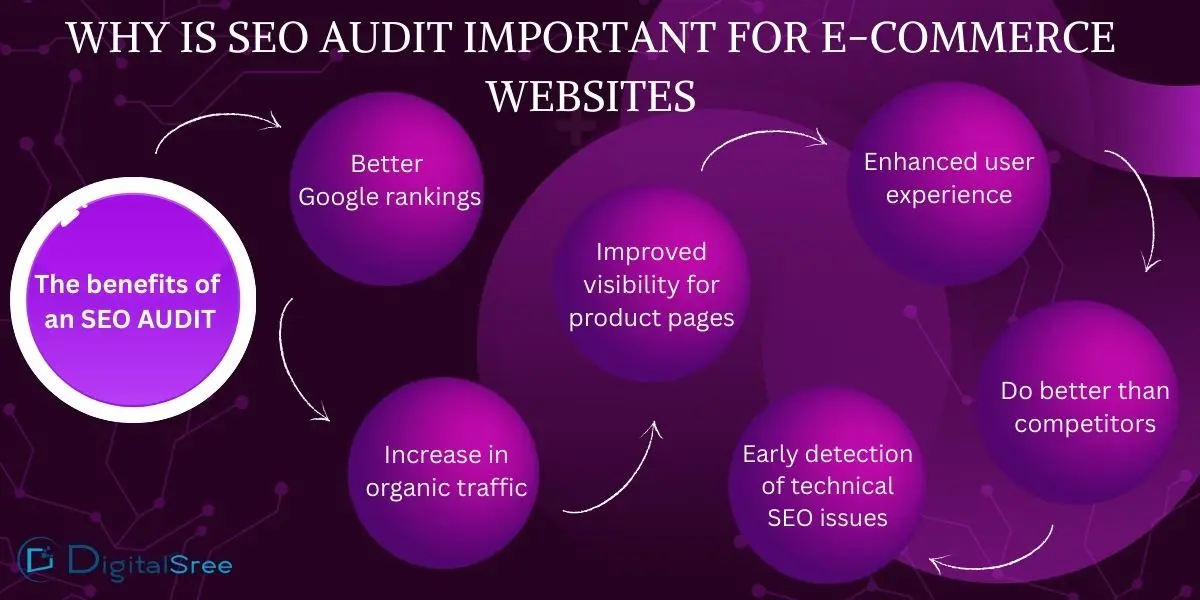
An SEO audit will help online store owners understand website traffic, what is working, and what changes are required for their website
Benefits of An SEO Audit:
- Better Google rankings
- Increase in organic traffic.
- Improved visibility for product pages
- Enhanced user experience
- Early detection of technical SEO issues
- Do better than competitors
If an SEO audit is not conducted, websites may face more issues, such as insufficient keywords. slow speed, indexing issues, and duplicate content. These issues can negatively affect the overall performance
Types of E-commerce SEO Audits
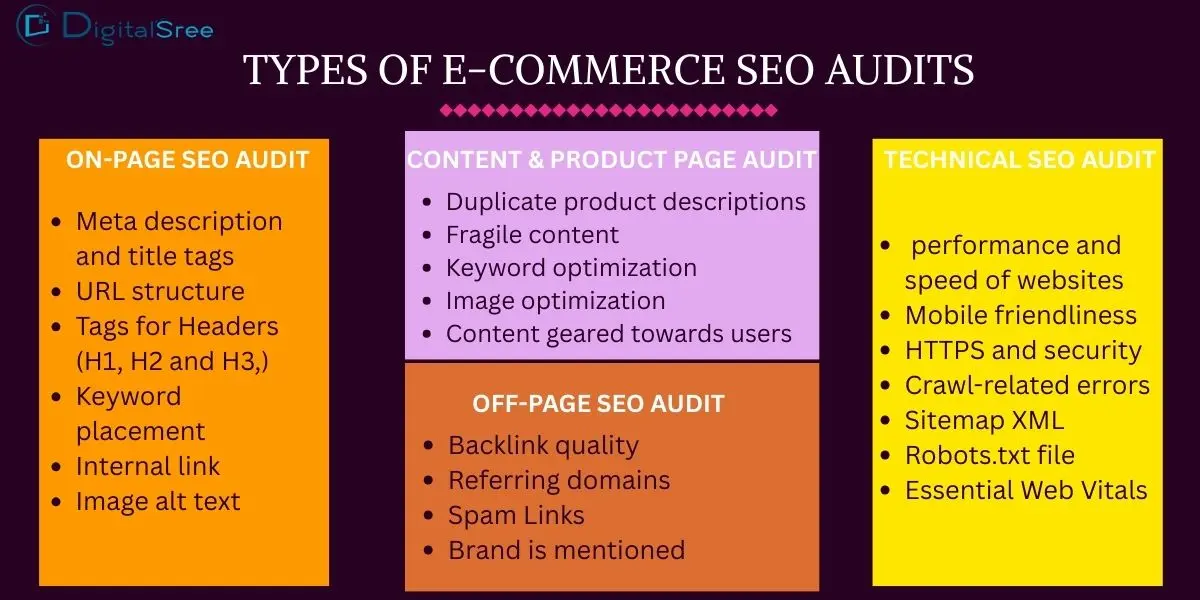
There are various kinds of E-commerce SEO audits. Each one is focused on a particular section of your website. Content and product page seo audit, technical seo audit, on-page and off-page SEO audit.
Technical SEO Audit for E-Commerce Websites
A technical SEO audit for e-commerce checks whether search engines can easily crawl and index your website.
It comprises:
- Speed and performance of websites
- Mobile-friendliness
- HTTPS and security
- Crawl-related errors
- Sitemap XML
- Robots.txt file
- Essential Web Vitals
In an e-commerce SEO audit, finding pages marked as Crawled – Currently Not Indexed helps improve indexing and organic traffic. A broken or slow website can affect rankings even if your content is excellent.
On-Page SEO Audit for E-Commerce Stores
Both e-commerce conversions and search engine optimization depend on products that are meaningful and distinctive.
It is a check:
- Meta description and title tags
- URL structure
- Tags for Headers (H1, H2 and H3,)
- Keyword placement
- Internal link
- Image alt text
Product or category pages are among the specific pages that are examined in an on-page SEO audit.
Content & Product Page SEO Audit
This SEO audit evaluates how you can improve the quality of the content you have created, including product descriptions.
It Consists Of:
- Duplicate product descriptions
- Fragile content
- Keyword optimisation
- Image optimisation
- Content geared towards users
Informative and unique product descriptions are the key to SEO success.
Off-Page SEO Audit for E-Commerce
An Off-page SEO audit for e-commerce examines the authority of your website and its reliability.
It is a check:
- Backlink quality
- Referring domains
- Spam Links
- Brand is mentioned
The strength of backlinks can boost authority on the domain and can help you rank in the search results for competitive keywords.
It is a check:
- Meta description and title tags
- URL structure
- Tags for Headers (H1, H2 and H3,)
- Keyword placement
- Internal link
- Image alt text
A good on-page SEO strategy helps Google better understand your website and rank it accordingly.
SEO Audit Checklist for E-commerce
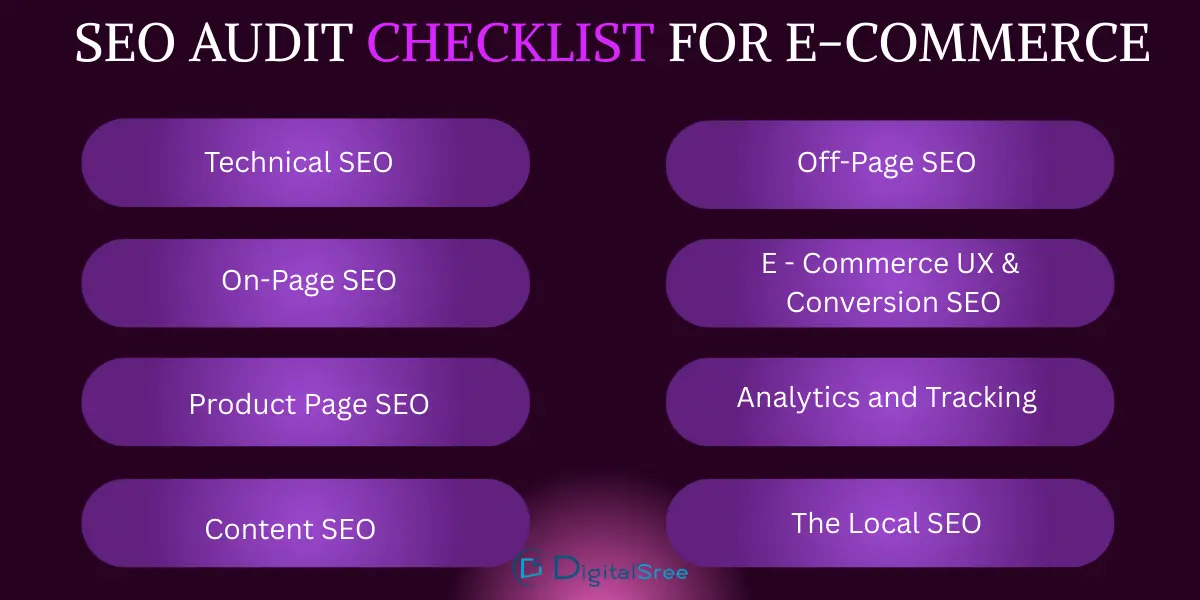
A good on-page SEO strategy helps Google better understand your website and rank it accordingly.
1.Technical SEO Checklist for E-Commerce (Important)
Website Indexing & Crawling:
- Google crawls all of the most important pages of the site.
- There are no essential pages blocked by robots.txt.
- XML sitemaps submitted to Google Search Console.
- The sitemap is updated regularly.
- No index/no follow tags on pages for products.
- Canonical tags are correctly used.
Website Speed and Performance:
- Page load time is less than 3 seconds.
- Image compression. (WebP preferred)
- Lazy loading enabled.
- JavaScript as well as CSS is minified.
- Server response time is optimised.
- CDN enabled. (if it is)
Mobile Optimization:
- Design that is mobile-friendly and fully mobile
- Responsive layout for all devices
- Mobile navigation is simple and easy on the mobile
- Buttons and CTAs that can be clicked
- No intrusive pop-ups
Essential Web Vitals:
- LCP under 2.5 seconds
- CLS under 0.1
- INP optimized
- The test was conducted using the PageSpeed Insights tool.
Website Security:
- HTTPS is enabled.
- The SSL certificate is valid.
- No mixed content errors.
- Secure payment gateway.
2. On-Page SEO Checklist for E-Commerce
Title Tags and Meta Descriptions:
- Unique title for every page
- The primary keyword is included naturally.
- Title length: 50-60 characters
- Meta description written by humans
- No duplicate meta tags
URL Structure:
- Short, clean URLs.
- URLs should avoid random symbols and unnecessary numbers.
- Keyword-rich URLs.
- Proper hierarchy of categories.
Header Tags (H1, H2 and H3,):
- One H1 is allowed per page.
- H1 includes the main keyword.
- H2 and H3 are used to describe subtopics.
- Headings that are readable and well-structured.
3. SEO Checklist for Product Page
- Unique product descriptions. (no copy-paste)
- A minimum of 300-500 words is required for the main product.
- Keywords are words that are naturally used.
- The product name is optimized.
- High-quality images.
- Image alt text has been added.
- Price, availability, and reviews are visible.
- Product schema implemented
- Customer reviews enabled
4. Content SEO Checklist for E-Commerce
- The pages are not thin or devoid of content.
- No duplicate content.
- Blog content supports product pages.
- Long tail keywords include.
- FAQs have been added to the pages.
- Content is regularly updated.
5. Off-Page SEO Checklist
Profile for Backlinks:
- Top-quality backlinks from relevant sites.
- No toxic or spammy links.
- Anchor text with a balance.
- Branded anchor link included.
Brand Signals:
- Social media profiles linked
- Brand names are tracked.
- Businesses are listed in directories.
6.UX & Conversion SEO Checklist for E-Commerce
- Simple navigation.
- Clear CTA buttons.
- Simple checkout procedure.
- Multiple payment options.
- Trust badges can be seen.
- Rapid checkout speed.
- SEO and Conversion Rate Optimization
Improving navigation, CTAs, and the checkout process is essential to increase e-commerce CRO and boost sales from organic traffic.
7. Analytics and Tracking Checklist for E-Commerce SEO
- Google Analytics installed.
- Google Search Console connected.
- Conversion tracking is enabled.
- Tracking e-commerce is active.
- Monitored error pages.
8. The Local SEO Checklist for E-Commerce (If It's applicable)
- Google Business Profile optimized.
- NAP consistency.
- Local keywords are used.
- Local reviews encouraged
Internal Linking Strategy for E-commerce SEO Audit
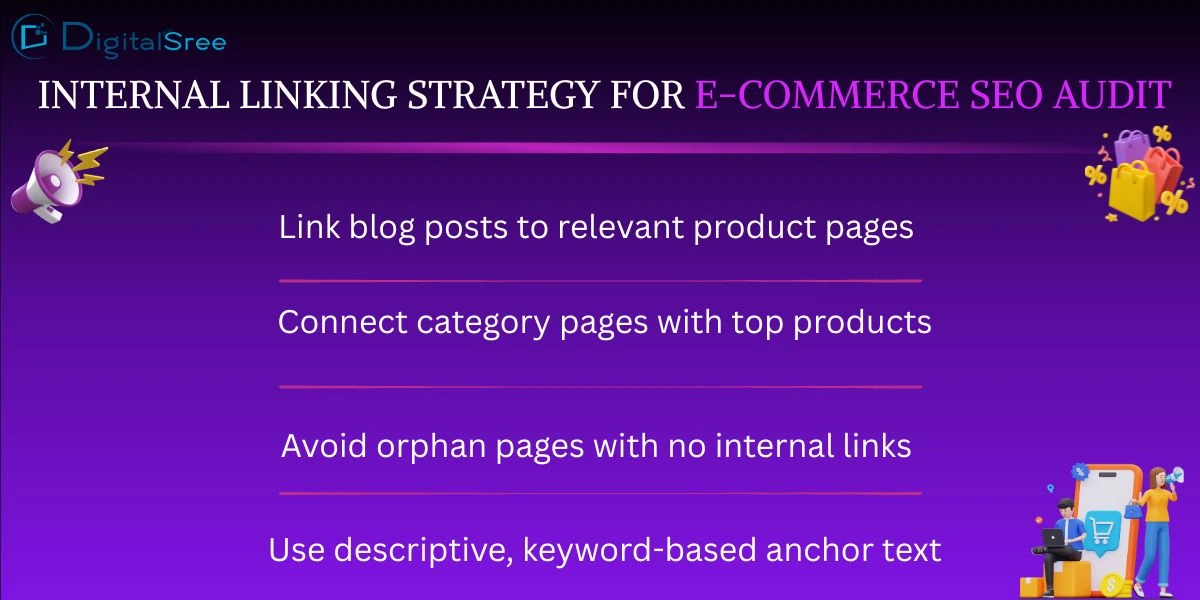
Internal links in an E-commerce SEO audit is very important to search engines to find the important pages of the site and improve the ranking flow of the site.
Best internal linking practices:
- Link blog posts to relevant product pages.
- Connect category pages with top products.
- Make use of descriptive anchor texts that include the use of relevant keywords.
- Avoid pages that have no internal links, called orphan pages.
- Strong internal linking improves crawl ability and user navigation.
Best Tools for SEO in E-commerce Audit
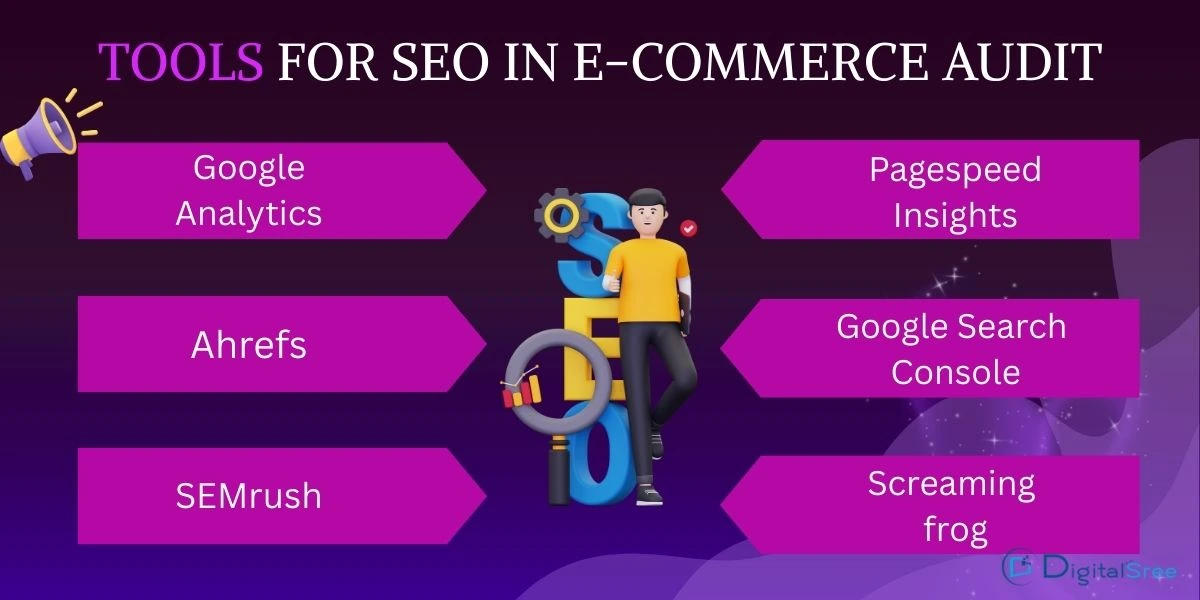
Best SEO tools help audits run faster and more precisely.
E-Commerce SEO Auditing Tools:
- Google Search Console.
- Google Analytics.
- Ahrefs.
- SEMrush.
- Screaming Frog.
- PageSpeed Insights.
These tools help identify SEO mistakes, ranking issues, and improperly used keywords.
Common E-commerce SEO Audit Mistakes
Many store owners who run online stores make the wrong mistakes during E-commerce SEO audits.
Most common mistakes to be avoided
- Inattention to technical SEO.
- Copying product descriptions.
- Keyword stuffing.
- Not optimizing pages for categories.
- The mobile optimization process isn’t being done.
You can stay in a stronger position by avoiding these mistakes.
How frequently do you need to do an SEO Audit for E-Commerce?
An SEO audit for e-commerce must be conducted
- Every 3 – 6 months.
- After significant updates to the website.
- If traffic suddenly slows.
- In the lead-up to the launch of new products.
Regular audits can help keep your store in the game and SEO-ready.
SEO Best Practices for E-commerce Websites (2026)

To easily rank on Google by 2026:
- Be focused on the intent of your search.
- Create valuable, human-written content.
- Optimize your website for voice search and AEO.
- Use structured data. (schema)
- Improve page experience.
Google places a high value on expertise, experience, and confidence rather than keyword stuffing. Keyword proximity in SEO helps search engines understand your content better.
Final Thoughts
E-commerce stores with a lot of E-commerce SEO audits know how to find and improve specific weaknesses in their stores. It also checks the technical improvements of the store.
An e-commerce SEO audit also analyzes how easily content can be found in order to improve a store’s ranking for what people are searching. Improving store content is what an e-commerce SEO audit is primarily focused on.
For all Shopify, WooCommerce managers, and large e-commerce platform managers, we can say with confidence that regular SEO audits will provide sustained growth for your business and will provide you with a steady influx of traffic. With the right tools and strategies, customised to your e-commerce store, you will be ready to face the competition of 2026 and beyond.
Frequently Asked Questions (FAQs)
1. What are the goals of an e-commerce SEO audit?
The goals of an e-commerce seo audit include improving the rankings of the search engines, increasing the number of website visitors, and fixing the major SEO issues that are blocking sales.
2. Should small e-commerce stores get SEO audits?
Definitely, they need to do as much as possible to overcome their competitors, mainly the large stores.
3. Can I conduct my own SEO audit for e-commerce?
Of course, for beginner-level SEO, audits are also beginner-level tasks, and can be implemented using the basic structures of the available SEO tools.
4. How long does an e-commerce SEO audit take?
It may take an audit anywhere between a couple of hours and days, depending on how e-commerce operations are structured.
5. Does an e-commerce SEO audit help improve a website's google ranking?
The SEO audits do not rank the sites highly; they only show the issues blocking the sites from ranking. Only after the issues are fixed can the changes be implemented for the rankings to improve. And based on that, the ranking can be improved.