
What Is Personal Branding? Powerful Truths That Will Transform Your Career in 2026

What is personal branding? Why does it matter more now than it used to? Picture two people. Almost the same skills. One gets the client call. One gets the interview. The other one just… doesn’t hear back. That gap usually has nothing to do with talent. It comes down to what shows up when someone searches a name, or what a mutual connection says in passing before an introduction even happens. That’s the part most people never think to manage on purpose. This guide is about what personal branding actually means, why it works the way it does, and how you’d actually go about building one, step by step, without all the fluff and buzzwords usually wrapped around the idea.
What Is Personal Branding?
What is personal branding, really, once you strip the buzzwords out of it? It’s how people perceive your skills, your values, and your professional reputation. By 2026, it’s grown into something much bigger than a social media bio. It quietly decides who gets trusted before a meeting even starts. Here’s the simplest way to say it. A bio gets written once, and then nobody looks at it again. A personal brand gets earned. Bit by bit. Whether you’re paying attention to it or not. The importance of personal branding shows up early, often long before you’ve applied for a job or pitched a single client.
A Short History of the Idea
This didn’t start with Instagram. It just feels that way sometimes. Credit goes to management consultant Tom Peters, who wrote a Fast Company cover story in August 1997 called “The Brand Called You.” His point was blunt. No matter your age, your title, or your industry, you had to start treating yourself like a brand.
What actually changed isn’t the idea itself. It’s the reach. One LinkedIn post can put your personal brand identity in front of thousands of strangers now—people who’ll never sit across a table from you. Peters didn’t have that in 1997. His readers had résumés, handshakes, and word of mouth. That was pretty much it.
Why Is Personal Branding Important?
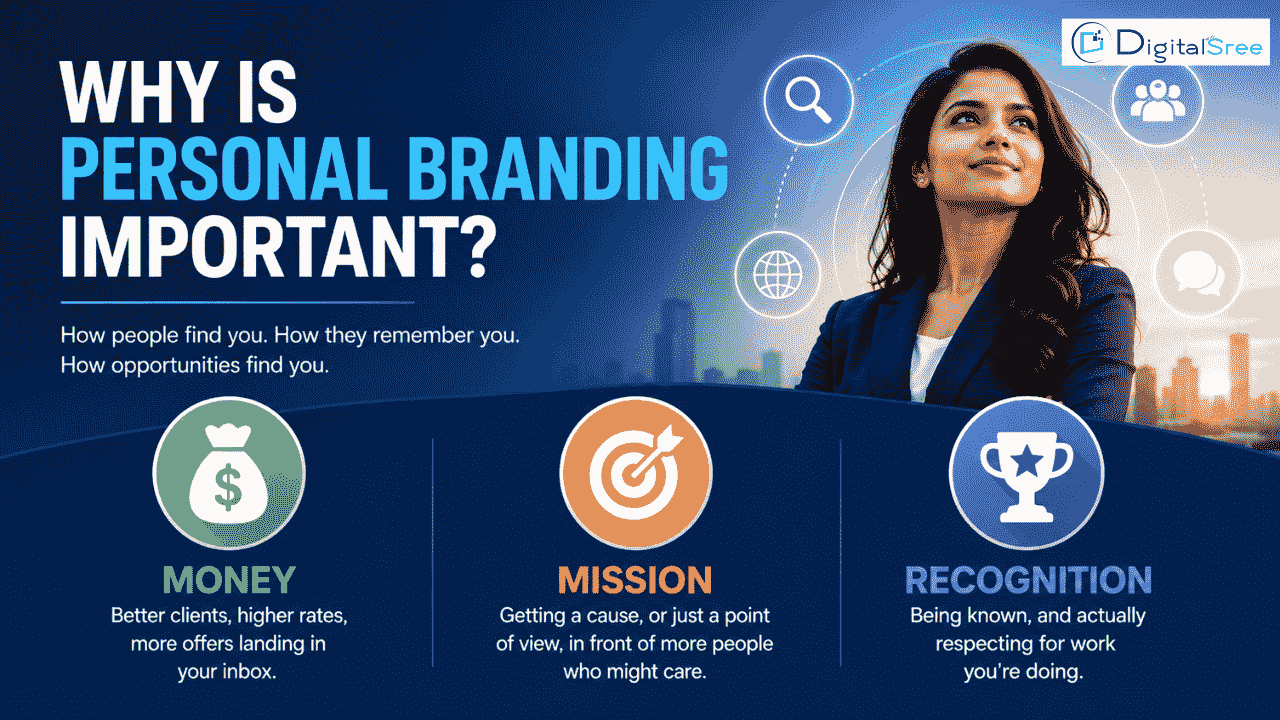
So what is personal branding once you get past the textbook version? It shows up in search results. In how someone introduces you at an event. In the first minute or so someone spends deciding what they think of you. That’s really the whole reason it matters, if you think about it.
Money, Mission, and Vanity: The Three Motivators
Most people build a personal brand for one of three reasons. Sometimes all three at once:
1. Money
Better clients, higher rates, more offers landing in your inbox.
2. Mission
Getting a cause, or just a point of view, in front of more people who might care.
3. Recognition
Being known, and actually respected, for the work you’re doing.
Which one is driving your changes a lot downstream, including which platform even makes sense for you to spend time on? Copying someone else’s personal branding strategy when your motivation is completely different rarely works out. This is where the importance of personal branding stops being some abstract idea floating around and turns into an actual plan you can follow.
The Importance of Personal Branding, Backed by Data
Employers are already checking whether people realise it or not. CareerBuilder’s social media recruitment survey found 70% of employers screen candidates on social media before hiring. 54% say they’ve found something that completely changed their mind about a candidate. Word of mouth still beats almost everything else in professional decisions, and it’s not close. People trust a recommendation from someone they actually know over an ad, pretty much every single time. That’s the same kind of trust a personal brand is trying to earn. Your reputation shows up ahead of you now.
In negotiations. In pitches. In interviews. Doesn’t matter if you shaped it on purpose or just let it happen by accident. None of this only applies to influencers, either. Personal branding for freelancers, personal branding for students, personal branding for professionals stuck in fairly ordinary jobs- all of it matters. Not just personal branding for people who are already famous. The importance of personal branding scales down just as well as it scales up. Maybe even better, honestly.
How Does Personal Branding Work?
A personal branding strategy that actually holds up starts with identity. Not tactics. That’s why the questions below come before anything about posting schedules or content calendars. The Four Questions That Define Your Identity: Sit with these first, before you touch any tactics at all.
1. Why am I doing this? Your real reason. Not the one that sounds good in an interview.
2. What do I want to be known for? Your niche. Your angle on things.
3. Who am I, really? Your values, your tone, whatever actually sets you apart from everyone else doing the same thing.
4. How do I get there? Whatever content and visibility plan follows naturally from the first three answers.
Most advice on personal branding strategy skips straight to “post consistently” without bothering to answer any of this. That’s a big reason so many personal brands end up feeling identical to each other. They’re built on tactics stacked on top of nothing, with no real personal brand identity actually holding it together underneath.
Personal Hook + Professional Punchline
A strong personal brand usually comes down to two things working together. Your personal hook is the human part: your background, your quirks, whatever story makes you relatable to a stranger. Your professional punchline is the actual expertise or result you deliver. One without the other just doesn’t work well. Expertise with no hook reads as generic. Personality with no expertise is noise, plain and simple. The personal branding examples further down show what it looks like when both are present at the same time.
How to Build a Personal Brand Step by Step
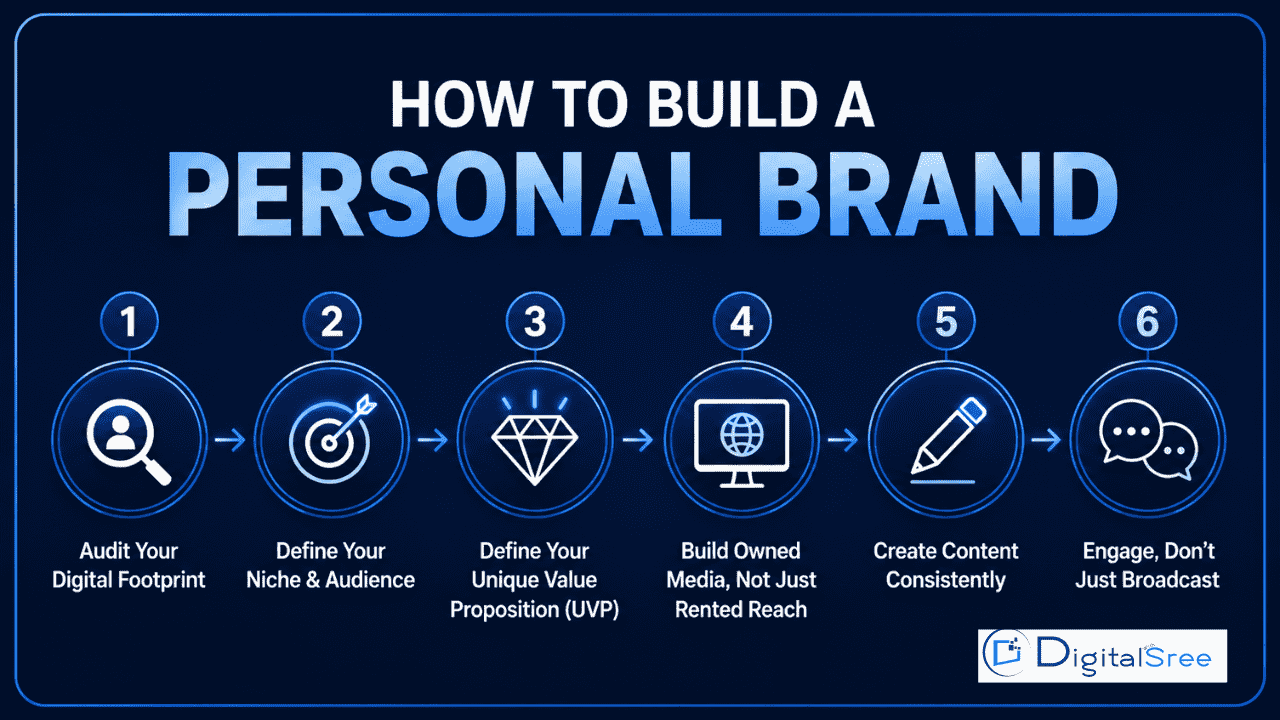
A personal branding strategy in six steps. Roughly in the order you’d actually tackle them.
Step 1: Audit your current digital footprint
Search your own name. See what’s really sitting on the first page of Google right now. Check if your LinkedIn and Instagram actually match how you want people to see you.
Step 2: Define your niche and audience
Get specific here. ” Digital Marketing” is a category. “SEO for D2C skincare brands” is a niche. The narrower you go, the faster you turn into the obvious choice for that particular group of people.
Step 3: Define your unique value proposition (UVP)
Ask yourself, honestly, why someone would pick you over ten other people with roughly the same credentials. A real UVP is specific. A methodology. A track record. A way you talk to people that’s just yours. “I’m passionate and hardworking” says close to nothing at all.
Step 4: Build owned media, not just rented reach
Social platforms are rented land, and always will be. One algorithm change, one locked account, and years of effort can disappear in an afternoon. A personal website or blog is home base. It’s actually yours. No landlord involved.
Step 5: Create content consistently
Posts that genuinely teach something build way more trust than anything that reads as promotional. Posting every couple of weeks with real substance beats posting every day with nothing worth saying.
Step 6: Engage, don't just broadcast
Reply to comments. Actually answer what people ask you. Personal branding works more like a relationship than a billboard. It stops working the moment it turns into a one-way street.
Personal Branding Examples
These personal branding examples run from household names all the way down to an ordinary freelancer. So you can see the same pattern play out at very different scales.
Well-Known Examples
Emma Watson’s move from acting into UN Women advocacy is a good one. It shows a personal brand growing into something mission-driven, over years, not overnight.
Elon Musk’s public identity is tied tightly to big, risky projects. For better or worse, that’s just the association people make with his name.
Gary Vaynerchuk built his brand around one consistent voice, repeated pretty much everywhere he shows up, year after year.
A Practical Example: Freelance SEO Consultant
These personal branding examples wouldn’t feel honest without one that has nothing to do with celebrity at all. So here’s what it actually looks like, month by month, for somebody starting with zero public profile.
- Weeks one through four. They audit their own LinkedIn and realise it reads like a résumé, not a speciality. The headline gets rewritten around something specific. Say, “SEO for Gulf-based industrial and B2B websites,” instead of a generic job title nobody remembers five minutes later.
- Months two and three. One detailed post goes out roughly every two weeks, breaking down a real, anonymized audit. What was wrong. What got fixed. What changed because of it. No selling. Just the actual process, laid out plainly.
- Months four through six. Two or three client testimonials and a before-and-after case study land on a personal portfolio site. So all those LinkedIn posts finally have somewhere to send people.
- Month six and beyond. Messages start showing up that reference specific posts. Something like, “Saw your breakdown on noindex tags, could you take a look at our site?” Not cold pitches anymore. Actual, warm interest.
Underneath all of it is something fairly simple. Consistent, specific content, plus one owned platform to hold it all. Same framework from the step-by-step section above. Just actually put into motion this time.
What ties every example here together is this. Each brand repeats one clear identity instead of scattering a dozen unrelated messages around. If you’re still not sure which direction fits you best, it’s worth rereading these personal branding examples before locking in a personal branding strategy of your own.
Common Personal Branding Mistakes
The personal branding examples above show what tends to work. Even a carefully built personal branding strategy falls apart without consistency behind it. Here’s what usually goes wrong, in no particular order.
- Picking a niche so broad that nobody remembers it afterward.
- Being inconsistent. Two weeks of posting, then two months of silence.
- Copying someone else’s voice instead of just finding your own.
- Ignoring the questions and comments people actually leave you.
- Only ever posting to sell, and never to teach or share anything real.
Personal Branding vs. Reputation
A personal branding strategy with no real reputation behind it just doesn’t hold up for very long. A personal brand is what you deliberately put forward. Your reputation is what people actually believe about you, based on real experience with you, not the version you’re projecting to the world. These two should line up. But they aren’t the same thing, and mixing them up is a mistake the personal branding examples above make fairly obvious.
The Oak Tree of Reputation
Reputation takes years to build and almost nothing at all to damage. An oak tree can take decades to grow and get cut down in under an hour. One dishonest moment is really all it takes to undo a lot of that work.
Front Stage vs. Backstage
Sociologist Erving Goffman described this well, years back. He talked about a “front stage” self, the polished version people show publicly, versus a “backstage” self, the unfiltered one that only exists in private. A personal brand holds up best when that gap between the two stays small. One built entirely on a curated front stage, with nothing real behind it, tends to fall apart the first time somebody actually puts it to the test.
Expert Insights: Staying Authentic While Building a Brand
Fair criticism, honestly. Treating yourself like a “brand” can start to feel like turning a person into a product. But the answer isn’t giving up on personal branding altogether. It’s staying authentic while you do it anyway. Show the real limitations right next to the real wins. Be upfront that this takes actual time, and that it can bring real pressure to perform some version of yourself day after day. A brand that never once admits a mistake starts to look manufactured instead of aspirational. Recognising the importance of personal branding also means recognising exactly where it stops. It supports your reputation. It can’t replace actual skill, no matter how carefully it’s built.
Free Brand Audit Checklist
Use this to pressure-test your personal branding strategy before you actually start building anything at all.
Run through these questions to audit your current personal brand identity.
- What’s the one sentence people who know me professionally would use to describe me?
- Does the first page of Google results for my name actually match how I want to be seen?
- Is my LinkedIn headline specific, or could it honestly belong to almost anyone?
- Do I have at least one piece of owned content, a website, a blog, a portfolio, that isn’t stuck depending on some social platform?
- Have I posted anything in the last two weeks that actually teaches something, instead of just selling something?
- Could a total stranger figure out my niche within about ten seconds of looking at my profile?
Conclusion
Personal branding was never really about chasing fame or manufacturing some persona. It is s about becoming known, deliberately and consistently, for something specific and true about you. The importance of personal branding lies less in visibility and more in consistency and honesty. It is not about being seen by everyone- it’s about being remembered correctly by the right people, whether that’s a client, a hiring manager, or someone who stumbles across one post at exactly the right moment.
Start with an honest audit of your digital footprint- pick one niche. Commit to actually showing up, even on the days it feels like nobody’s paying attention. If you need a reference point for what that consistency actually looks like, go back over the personal branding examples above and notice how ordinary the process really is behind the results. The compounding starts slower than you’d like. But once it starts, it really doesn’t stop.
FAQ
1. What is personal branding?
It’s the ongoing process of shaping your reputation. Basically, how people see your skills, your values, and your expertise, both online and off.
2. Why is personal branding important in 2026?
Because employers, clients, and collaborators are already looking people up online before they ever actually meet them. Whatever turns up when someone searches your name genuinely shapes what happens after that.
3. How do I build a personal brand from scratch?
Start with an honest audit of your digital footprint. Pick one specific niche. Stick with substantive content instead of posting in random bursts whenever you feel like it.
4. Is personal branding only for freelancers and influencers?
Not really, no. Personal branding for students and personal branding for professionals in ordinary jobs both matter too. A strong LinkedIn presence can shape a hiring decision long before anyone even applies.
5. What's the biggest personal branding mistake people make?
Inconsistency, by a pretty wide margin. A burst of posts followed by months of nothing does more damage to how reliable you seem than posting less often but actually sticking with it long-term.