
Top 5 Benefits of Artificial Intelligence in Business Growth
Artificial intelligence (AI) is transforming the world by making technology smarter and more efficient across many industries, such as health care, finance, online shopping, and communication. The scope of artificial intelligence is wide, as it supports innovation, improves efficiency, and creates new opportunities for businesses of all sizes, including AI for small business growth and development.
The impact of AI in the world is growing rapidly as AI systems learn from data, make accurate decisions, and automate complex tasks. Understanding the benefits of artificial intelligence in business is important because AI helps reduce costs, improve customer experience, and support better decision-making. This is why AI is important for business growth, helping companies increase productivity, stay competitive, and adapt to changing market needs.
5 Key Benefits of Artificial Intelligence in Business
1. Improved decision-making
One of the key benefits of artificial intelligence in business is improved decision-making. AI uses data-driven insights to help enterprises understand information clearly and make smart choices without guesswork. With predictive analytics, AI can analyse past data to predict future trends and customer behaviour, helping businesses plan ahead and reduce risks. AI also provides real-time reporting, allowing companies to track performance instantly and respond quickly to changes. These features highlight the major advantages of artificial intelligence in business, making decision-making faster, more accurate, and more reliable.
2. Increased efficiency and automation
Increased efficiency and automation are major advantages of artificial intelligence in business. Artificial intelligence in India is helping businesses with task automation by handling repetitive and time-consuming tasks such as data entry, email responses, and inventory updates. AI also supports process optimisation by analysing workflows and finding faster and better ways to complete tasks. Another significant advantage is time-saving workflows, in which AI technologies work without interruption and perform tasks significantly faster than manual techniques. Because of this, businesses can improve productivity, reduce costs, and operate more smoothly using AI powered automation.
3. Cost reduction
Cost reduction perhaps has been one of the most striking examples to show the impact of artificial intelligence on business. AI supports companies in reducing labour costs by automating routine tasks; therefore, businesses require less manual effort for repeated work. AI also supports the optimisation of resources by analysing data to prevent wastage and utilise time, money, and material resources more effectively. Additionally, AI helps reduce operational costs through better planning, reduced errors, and the prevention of costly mistakes, because of which AI makes businesses cost-effective and economically stable.
4. Better customer experience
Improved customer experience is one of the major benefits of artificial intelligence in the business world because it assists businesses in handling customers in a smarter and more effective way. Moreover, artificial intelligence assists in faster responses through the use of chatbots that respond instantly to customers’ questions without keeping them waiting. Another important factor is that customers can contact them at any time of the day because of 24/7 customer service availability. Additionally, businesses can provide customers with personalised experiences due to the ability of artificial intelligence to identify customer behaviour and patterns.
5. Higher productivity
Higher productivity is a major reason why companies adopt AI, as the advantages of artificial intelligence in business include smarter task management and better efficiency. AI reduces repetitive work so employees can focus on high-value tasks, while streamlined workflows help teams work faster and more accurately. This results in enhanced employee output and consistent productivity growth across the business.
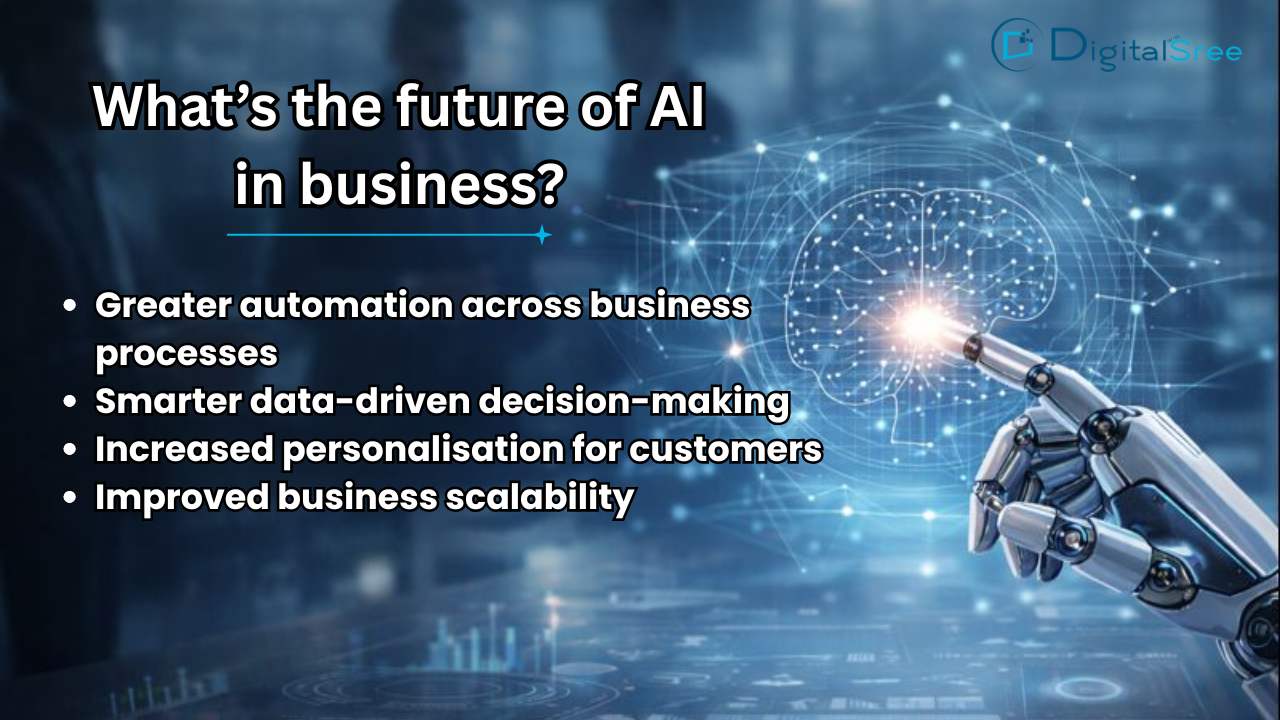
1. Greater automation across business processes
The importance of artificial intelligence in business is clearly seen in how it enables greater automation across daily operations. The future of artificial intelligence in digital marketing reflects this shift, as AI is widely used by experienced and trusted businesses to handle repetitive tasks such as data entry, reporting, and basic customer support. This reduces human errors, saves valuable time, and allows employees to focus on important and skilled work, making business processes more efficient and reliable.
2. Smarter data-driven decision-making
Smarter data-driven decision-making helps businesses plan better, reduce risks, and grow with confidence by using accurate and real-time insights. By analysing large amounts of information quickly and clearly, AI supports reliable choices and strategic planning, making this one of the key benefits of artificial intelligence in business.
3. Increased personalisation for customers
AI helps businesses understand customers’ needs through the analysis of behaviour and past interactions. This enables companies to offer personalised products, messages, and services that build trust in the company. This improves customer satisfaction and will have a strong long-term relationship
4. Improved business scalability
The AI system has the capacity to handle more tasks as the business grows. Most successful businesses in the industry depend on the AI system to manage the increased workload without additional expenses.
1. Competitive advantage
Businesses that use AI gain a strong competitive advantage by working faster and smarter than others, which clearly shows the benefits of artificial intelligence in business. AI improves efficiency, reduces costs, and delivers better customer experiences. Many trusted and successful companies already rely on AI, proving through real-world experience that it helps businesses stay ahead in a competitive market.
2. Business growth and scalability
AI supports business growth by automating tasks and improving decision-making without increasing workload. It allows companies to handle more customers, data, and operations smoothly. This proven approach helps businesses scale efficiently while maintaining quality and performance.
3. Long-term value and future readiness
Implementation of AI at present will enable businesses to be future-ready since they will be developing a system that will be adaptable to changes and advancements in new technology and markets. The impact of artificial intelligence on businesses can be analysed from the perspective that AI influences increased productivity, accuracy, and innovation.
Conclusion
The increased use of artificial intelligence is changing the operations of businesses and improving efficiency, and aiding informed and better customer experience as well. The benefits of artificial intelligence in a business include automating repetitive activities and activities that do not require human intervention, and the provision of accurate information on the collected data by the business, as well as fast, personalised services.
FAQ
1. What is the importance of artificial intelligence in business?
The importance of artificial intelligence in a business organisation is its ability to enhance efficiency and save time. The technology is useful in providing a mechanism to automate repetitive business operations. It is also known to aid in making intelligent and informed business decisions. On the other hand, artificial intelligence increases customer satisfaction and helps a business organisation become a successful one.
2. What are the advantages of artificial intelligence in business?
The benefits of artificial intelligence in businesses include increased efficiency and effective decision-making. This also increases customer satisfaction through personalisation and fast service. Moreover, artificial intelligence applies to growing businesses and helps businesses to remain competitive.
3. What is the scope of artificial intelligence?
Artificial intelligence has been practised in some way in areas like healthcare, the financial industry, as well as the retail industry. It has been driving innovation, and hence the need to be used in the future.
4. What is the impact of artificial intelligence on business?
Artificial intelligence assists organisations in working faster and more efficiently for business success. This intelligence increases business productivity and provides various other benefits, such as cost savings and making organisations more competitive in their business environments and operations.