
Future of Digital Marketing in India: Strategic Roadmap to 2030
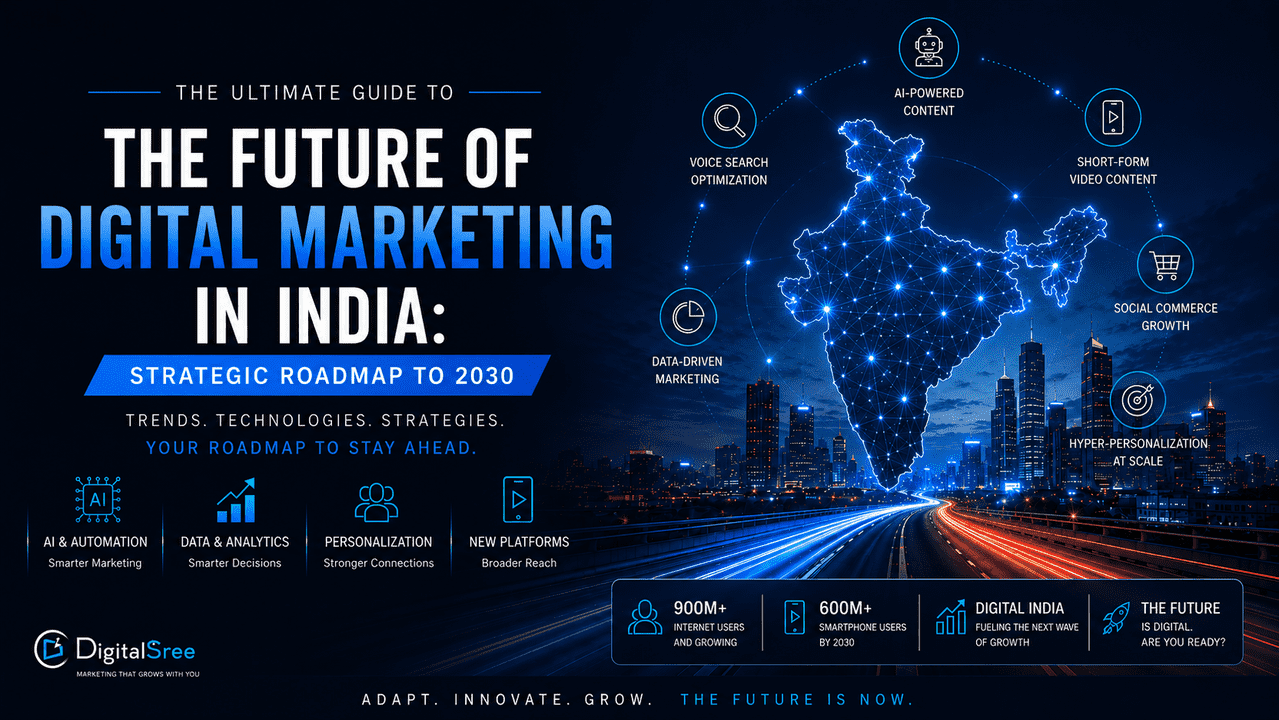
India’s digital marketing ecosystem is currently undergoing immense structural evolution, thanks to hyper-advancements in telecom and a soaring penetration of mobile-first-centric consumption in non-metro locations. Businesses need to make sense of the future of digital marketing in India to successfully operate within this value-led and privacy-conscious framework. As digital evolves, what must businesses do to remain competitive in an Indian context, keeping a tab on the latest digital marketing trends in India that are revolutionizing brand spending and evaluation?
This also marks the final decline of conventional ‘broadcast’ communication systems, as brands must now contend in a more local and interaction-led digital universe. By 2026, digital advertising in the total Indian advertising space will account for the lion’s share—46%. In a world now witnessing India growing as one of the fastest-growing digital markets thanks to cheap cellular data and high cellphone penetration,
the gravity center is moving towards “Bharat”—a conversational, mobile-first Indian consumer that resides in Tier 2 and Tier 3 cities. Brands that thrive and build according to the rules of this outcome-led commerce world now will win big in the next decade. This is a complete run-through of the various digital marketing trends and technologies that will dominate Indian marketing until 2030; read about AI in Future of Digital Marketing in India, performance marketing, marketing automation, and marketing analytics.
Understanding the Digital Shift
Digital marketing is about using the internet and other digital tools to tell people about products and services. This includes things like search engines, social media, websites, email, and mobile apps that let people talk back to you. It is different from the traditional way of doing things because it lets you talk to people in real time, pick exactly who you want to talk to, and see how well you are doing.
Nowadays, companies have to use marketing because that is where people are. For companies in India, digital marketing is not something extra—it is a main part of what they do. It helps smaller companies reach the people they want to and compete with larger companies without spending too much money.
People like to use the internet to find out about things and then buy them. This means that every time someone sees something about a company, it could lead to a sale. If a company uses marketing well, it can build real relationships with people and make content that they like. Future of Digital Marketing in India is really important for companies because it is where people are and it helps them sell things.
Growth Drivers of the Indian Digital Economy
India is a special case in the global context due to the extremely rapid expansion of its digital user base. By the end of 2025, 1.03 billion people in India were using the internet, which corresponds to a penetration rate of 70%. This growth is primarily due to the availability of affordable smartphones and mobile data costs being the lowest in the world.
The “Digital India” programme carried out a vital function by advancing digital literacy and infrastructure in rural areas, and as a result, trust and involvement in digital activities have grown among groups who have previously been overlooked and live outside the major metropolitan areas. Nowadays, digital marketing is more effective than traditional media at narrowing the gap between urban and rural markets.
The introduction of UPI has sped up this growth by making it possible to carry out instant digital transactions without friction. By July 2025, the number of UPI transactions had reached about 19.47 billion, enabling ‘watch-to-buy’ actions on social platforms. The seamless checkout process has reduced the distance between spotting a product and completing the purchase for millions of shoppers in India, and it is now one of the most evident digital marketing trends in the country, influencing current conversion-oriented strategies.
Future of Digital Marketing in India
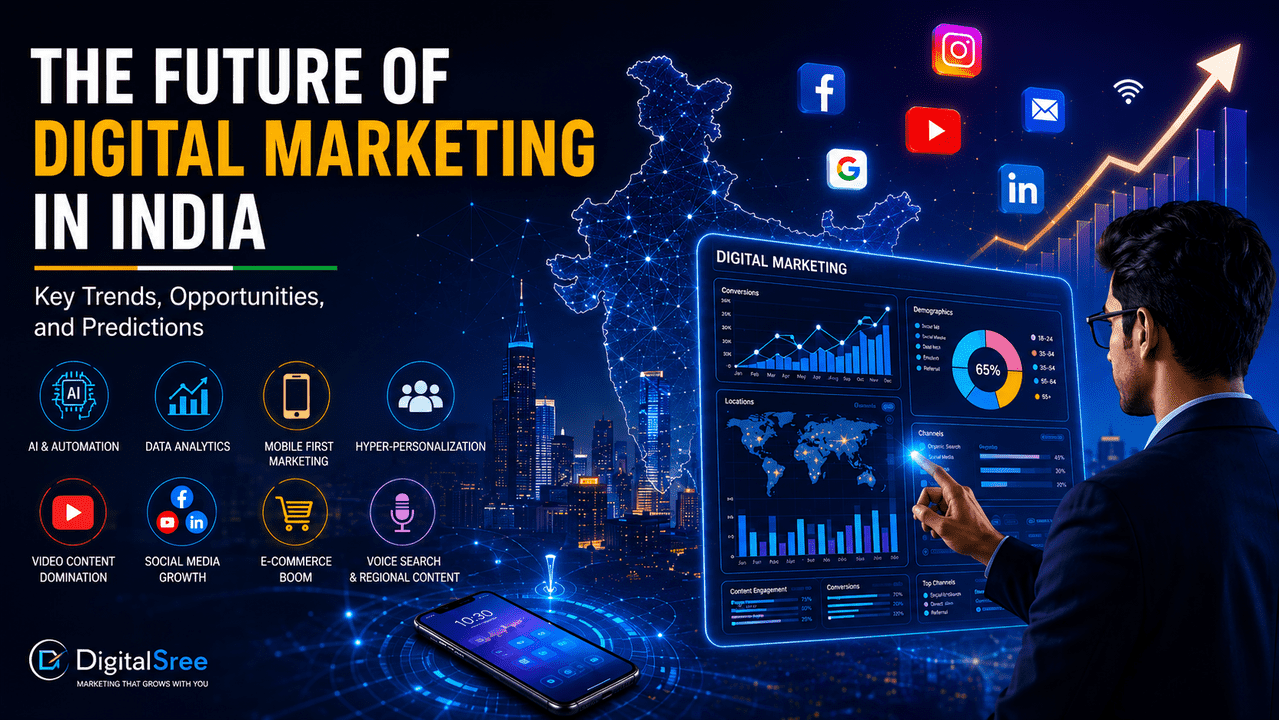
India alone is projected to have a digital market worth $33–$42 billion by 2030. This expansion will be characterized by a transition from volume-motivated acquisition to advanced, intelligence-powered engagement systems. This next decade of growth is still being constructed, with advanced artificial intelligence and programmatic automation laying down the infrastructure on which marketing automation and marketing analytics work as the operational backbone of any serious campaign.
Rise of Agentic Marketing
We’re seeing the beginning stages of agentic marketing in autonomous marketing systems. By the end of 2025, more powerful AI agents will be capable of designing marketing campaigns, launching them, and evaluating them on their own. One of the most prominent examples of AI in digital marketing today is the ability of agents to automate reporting and scheduling, empowering marketing teams to define the strategic parameters of their campaigns.
Agentic systems will be able to automatically collect, integrate, and analyze massive amounts of data to personalize marketing experiences with customers on an individual basis. Additionally, agentic systems will revolutionize customer service. By using AI in digital marketing to automate customer service, businesses will have the ability to provide 24 hours a day, 7 days a week customer support in any language, including those with regional variations. With the rapid advancement of multi-channel automated marketing systems, agentic systems will enable marketing teams to manage brand governance and control the marketing narrative with a high level of autonomy and very little human involvement.
Answer Engine Optimisation (AEO)
Traditional SEO is changing to Answer Engine Optimization as conversational AI becomes the main search interface. Brands are no longer trying to rank in a list of links; rather, their new target is to be mentioned by AI as the trustworthy source. This necessitates a transformation towards organizing content mainly for passage-level extraction and not mere keyword counting.
Searches via AI will give more and more customized results that take into consideration what individual users search for and their other behaviors. Marketing now mainly focuses on being an expert, having experience, being the leader, and trustworthy (E-E-A-T) to be included in AI-written summations. AEO will succeed with concise, trustworthy content created to instantly answer Indian consumers’ most common requests.
“Bharat” Vernacular Transition
Traditional search engine optimization (SEO) has morphed into Answer Engine Optimisation (AEO) as conversational AI increasingly becomes the go-to search tool. Instead of ranking in web address links, the new aim for brands is to get cited by AI as the most authoritative answer. This new development will require you to shift your strategy toward creating passage-level content that AI can extract without modification.
With AI-driven search engines, the results will get personal and more relevant by combining a user’s individual circumstances, preferences, etc. With that, marketers now have to focus a lot more on expertise, experience, authoritativeness, and trustworthiness (E-E-A-T) if they want to be the voice in AI-generated summaries. Great success in AEO demands creating short, factual, authoritative, and Indian consumer-oriented content that solves common problems.
Voice and Visual Search Adoption
Users in India speaking through voice search have shown a huge 200% rise in such searches in Hindi, with Hindi voice searches alone growing by 400%. As a result of this user behavior preference for speaking rather than typing, voice searches in local dialects have become longer, more conversational, with phrases and phrasal searches turning into natural language questions. Therefore, it is important for marketers to generate material that speaks to such naturally occurring voice searches at the local level.
Besides the use of tools like Google Lens for visual search, the way users find product information has changed. In consequence, marketers need to make their website or any marketing-related content searchable in a way that it can be interpreted both by a voice assistant and a text interpreter. Being able to tap into voice discovery behavior is critical for reaching the upcoming billion internet users in India.
Essential Digital Marketing Trends in India
The combination of intelligence, commerce, and fast 5G networks is making the online world a smoother and more engaging place. Companies that use intelligence, commerce, and fast 5G networks in a coordinated way will capture a big part of the fast-growing market in India. It is really important to know about the digital marketing trends in India like Connected TV and Quick Commerce.
This is necessary for any company that wants to have a marketing plan, especially if they also have a strong performance marketing plan. Artificial intelligence, commerce, and fast 5G networks are changing the way companies do marketing in India.
Connected TV (CTV) Expansion
Connected TV is now emerging as one of the favorite media choices to target affluent, tech-savvy households on the “big screen”. The base of connected TV households in India is expected to cross the 65-million mark by 2025, constituting 30% of all TV households. Such a development enables hyper-personalization and hyper-localization of programmatic advertising through premium live streamings like cricket.
Now, marketers have the luxury to employ automated content recognition data for their targeted advertising campaigns at the household level. CTV connects the world of traditional linear TV with digital performance measurement capabilities. This is made possible by the power of addressable advertising and the surge in free streaming ad-supported platforms.
Quick Commerce (Q-commerce) Integration
Q-commerce is transforming itself fast from a sales platform into a media platform for both insurgent and established brands. These platforms have advanced media solutions such as stories and post-checkout media solutions that compete with top-tier marketplaces. “Smarter Ad Timing” has become possible for brands, where they can reach out to their customers during certain periods for certain categories.
This platform is forecasted to generate 15% of overall e-commerce sales in India within a decade. Brands in the health, personal care, and electronics categories are increasingly experimenting and expanding their product portfolio through this platform. Success in this space depends upon time-starved urban buyers who prefer convenience and speed.
Creator Economy and Social Commerce
The creator economy in India consists of over 2 million monetized creators and is expected to impact $1 trillion in yearly expenditure by 2030. Social commerce is bringing down the sales funnel, as it enables users to purchase products directly from their social media feeds. Micro-influencers are valued for their authenticity and engagement rates with their followers in local niche markets.
The influencer marketing industry in India is expected to be worth ₹3,375 crore by 2026, with a CAGR of 25%. Shoppable posts and live shopping events are the fastest way to conversions for modern-day direct-to-consumer brands. Campaigns that involve influencers using regional languages have been proven to build better engagement and trust.
AI in Digital Marketing: More Than a Tool
AI in digital marketing is no longer just a tool; it has evolved into a complete partner in the implementation process. It is redefining the entire world of advertising as we move towards automation and result-driven approaches. Professionals who know how to leverage AI-based processes are believed to be three times more efficient than those who don’t and have been regarded as one of the key digital marketing trends in India.
Content Creation and Scaling
Generative AI technologies help create creative content on a large scale within the multilingual Indian regions. As an illustration, the brand Mamaearth uses AI-based platforms to create over 500 product descriptions per month, reducing the production process by 70%. The technology named “TasteMaker” has helped decrease the design process for the product concept from days to a matter of hours.
With the help of such technologies, personalized content can be created based on user preferences and history of visits. Generative AI helps in brainstorming topics for blogs, writing advertising copy, and even making outlines for videos in high definition.
Predictive Analytics and Demand Forecasting
The predictive analytics tools available to e-commerce and quick commerce brands enable precise forecasts of consumer demand. E-commerce grocery stores such as BigBasket rely on AI-based prediction of demand increases within their distribution centers with 90 percent accuracy. They assist in minimizing stock-outs and optimizing inventory while simultaneously increasing customer retention.
Predictive capabilities in AI dashboards transform complicated datasets into valuable insights for making practical decisions. Predictive capabilities in AI dashboards enable marketers to predict which segments are going to be more likely to convert before the launch of their campaigns. Such predictive capabilities are becoming increasingly relevant to managing logistics and inventory in the fast-paced Indian market.
Hyper-Personalization at Scale
AI helps create dynamic advertisements that cater to the geographical location, browsing history, and cultural elements of the user. Fashion retailers have created applications like “StyleGPT” to determine users’ style preferences and recommend an appropriate set of outfits. AI shopping assistants have been proven to enhance the conversion rate of customers by up to 30%.
Hyper-personalization is not just about recommendations but about creating experiences that are specific to the customer’s history. AI agents help analyze large amounts of data to ensure the right message reaches the right consumer at the right time. Such precise targeting was not possible in broadcast and traditional digital media.
Conversational AI and Customer Support
Indian companies are using sophisticated conversational AI for handling a huge number of customer interactions in various regional languages. The automated chatbot at ICICI Bank is capable of solving 80% of all customer queries by itself, leaving their human counterparts to deal with complicated transactions. These conversational bots let customers in Tier-2 and Tier-3 cities order goods through conversations in text form.
Conversational AI knows how to understand sophisticated language and give individualized solutions based on each client’s previous web activity. Sophisticated sentiment analytics lets companies keep track of what customers think of them in real time.
Performance Marketing for Measurable Outcomes
Outcome-based performance marketing relies heavily on results-oriented activities such as lead generation, conversion optimization, and sales rather than focusing on impressions. As competition intensifies, companies in India continue to shift to the outcome-based approach in their digital marketing to guarantee that every ad rupee helps drive business. To become successful in this industry, one needs to know how bidding works and how to optimize conversions. And performance marketing becomes more and more AI-driven in terms of digital marketing.
The main tools used in outcome-based performance marketing in India are Google Ads and Meta Ads. Numerous D2C brands have managed to scale revenue up to 500% in 90 days thanks to proper performance marketing strategy implementation. Story ads, reels, and branded search help reach users at different stages of their journeys.
Budget optimization in the industry is revolutionized by machine learning tools such as Google’s Performance Max and Meta’s Advantage + campaigns. Such platforms automatically manage bidding and targeting to achieve maximum ROAS. Modern performance marketers have to find a balance between such automated systems and human input, and testing results should be fed to reporting dashboards.
Marketing Automation and Intelligent Workflows
Marketing automation has moved beyond simple automation systems to becoming an agency that can manage complicated processes. It enables brands to ensure consistent engagements throughout the customer journey without manual intervention. When done right, it is like a productivity amplifier for smaller marketing teams and one of the biggest digital marketing trends for India when it comes to D2C and B2B brands.
Lead Nurturing and Customer Journeys
Automation of lead nurturing via WhatsApp and localized push notifications works well in the Indian market. A few brands have claimed that automation of WhatsApp prompts can improve their conversions up to 34%. This is achieved by creating customer retention routines through sending personal messages within 48 hours after initial interaction, which happens to be one of the most important marketing automation use cases.
Automation makes possible the creation of personalized email marketing campaigns for each of the subscribers. AI-driven solutions can help optimize both send time and subject lines in order to achieve higher open rates of up to 20% to 30%.
CRM and Workflow Automation
In place of CRM systems, enterprises are opting for Customer Data Platforms (CDPs), which enable them to organize their first-party data structures. The use of such platforms does not require third-party cookies since CDPs can integrate anonymous website sessions and known customer profiles. Similarly, automation helps small businesses run their intricate tasks such as inventory and payroll with little human effort.
The use of new-age tools like “ChatGPT Work” facilitates autonomous agents that carry out complicated processes for the company. These agents have been built to work alongside business systems such as Shopify, Slack, and Wix.
Making Data-Driven Decisions with Marketing Analytics
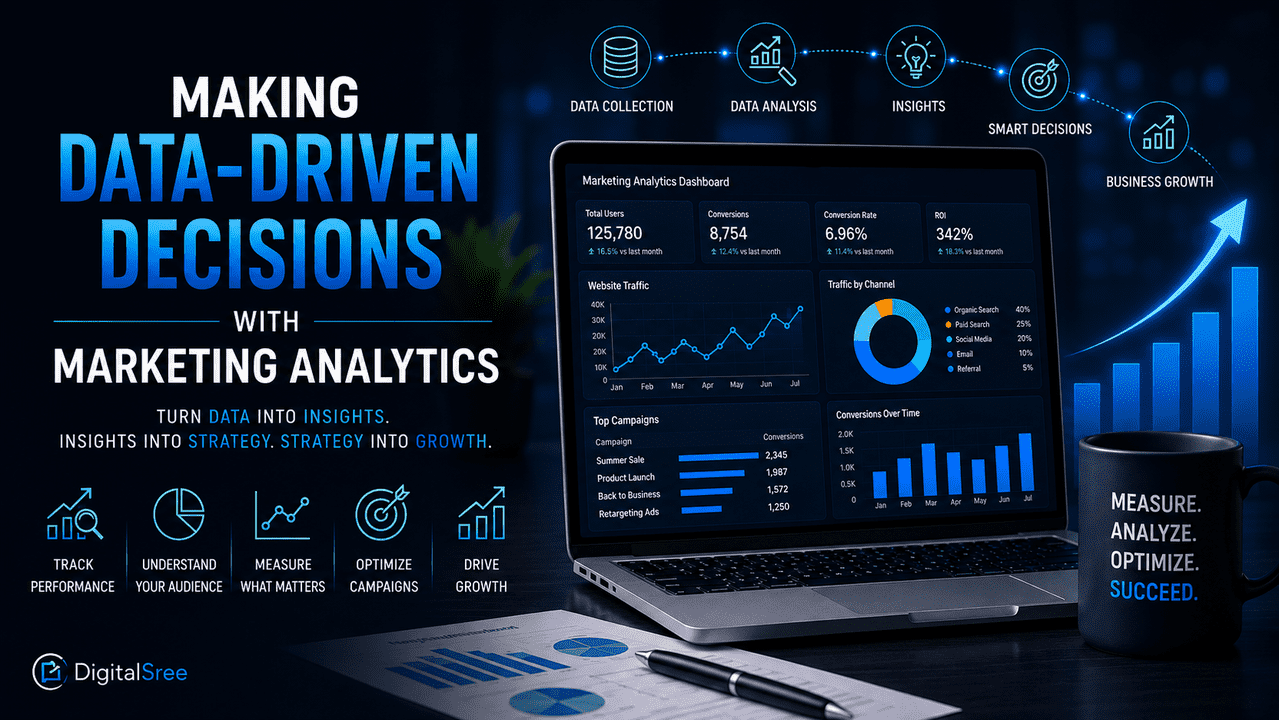
For marketers living in the data-rich world of 2026, marketing analytics is not about numbers; rather, it is about gaining insights that can be put into action. It is important for marketers to get past superficial measures such as “likes” and “reach” and concentrate on business impact and customer value. In order to make intelligent decisions in today’s fragmented marketplace, data literacy has become indispensable.
Google Analytics 4 and Attribution
Google Analytics 4 (GA4) with the use of AI-driven insights has emerged as the industry standard for monitoring users’ behavior and campaign performances. With customer journeys having become non-linear in nature, multi-touch attribution is an important requirement for ensuring that all touchpoints get due credit. This will help marketers get a grasp on how interactions during research phase affect the ultimate conversion path.
Modern analytics dashboards make it possible to convert complicated data points into straightforward and immediate reports, which can be acted upon by marketers instantly. Thanks to GA4 and BigQuery, there is high-level measurement maturity with regards to identity resolution across multiple devices and platforms. Such measurement maturity is crucial to modern marketing analytics.
Conversion Tracking and Signal Recovery
Deprecation of third-party cookies has rendered browser-based tracking techniques unreliable and inaccurate. In order to overcome the problem of losing signals, Indian companies are opting for secure server-based tracking pipelines using Conversions APIs on the platforms. By adopting such secure tracking pipelines, 25%-35% of lost signals can be retrieved for major platforms such as Meta.
By moving to server-side deployment, the website loading time is reduced along with better data privacy protection for the users. Companies that adopt server-side GTM containers will be able to stabilize their marketing campaigns while remaining compliant with the law.
Skills Businesses and Marketers Need for the Future
The shortage of skilled digital marketers in India remains higher than the existing demand for such professionals. To survive in the coming decade, digital marketers need to combine analysis, content, and knowledge about artificial intelligence. Flexibility has now turned out to be the most important superpower.
- AI Proficiency: Marketers must learn to use generative and predictive AI tools as multipliers for research and campaign execution.
- Data Literacy: The ability to interpret complex numbers and turn them into actionable business insights is now a mandatory skill.
- AEO and Content Strategy: Understanding passage-level writing and how to get cited by AI answer engines is critical for future visibility.
- Short-Form Video Production: The skill of scripting and producing high-impact Reels and Shorts is a core requirement for consumer brands.
- Emotional Intelligence: While automated systems handle routine tasks, humans must provide strategic thinking and brand empathy.
Challenges Businesses Should Prepare For
In spite of the fast growth witnessed, there exist a number of challenges that are faced by organizations with regard to the future of digital marketing in India. Ad fatigue is increasing among customers who are increasingly becoming choosy and cynical about marketing material.
Privacy Regulations and the DPDP Act
The implementation of DPDP Act 2023 will be the end of bulk marketing in India. Brand companies have been recognized as “Data Fiduciaries” and hold complete liability to prove that they have taken specific, informed, and revocable consent. Bulk messages and databases that are purchased have become a huge risk in compliance.
The act has used hefty penalties up to ₹250 crore in case there are any security violations that result in data breach issues. Marketers have to see to it that privacy notices are in different languages and also are unbundled from terms of services. This mandatory consent-based approach is now the base of consumer trust in India.
Rising Competition and Costs
With more brands venturing into the digital world, customer acquisition costs (CAC) have skyrocketed for all popular platforms. CAC for media on Quick Commerce platforms is growing so much that it now competes in parity with top sports show TV advertising costs. It is important to invest and be sustainable and profitable, rather than aiming for growth at any cost.
Media inflation and fierce competition demand that brands embrace data and geography strategies to boost their return on investments. It may be difficult for small and medium-sized businesses to keep up with large businesses with better resources and technology. The key to success lies in creating first-party data flywheels, performance marketing, and avoiding dependence on global tech firms.
Practical Action Plan for Indian Businesses
- Build a First-Party Data Flywheel: With third-party cookies disappearing, owning direct user signals is the only defensible competitive moat. Use interactive quizzes or surveys to capture compliant targeting signals directly from your customers, and feed them into your marketing analytics stack.
- Optimize for Mobile and UPI: Resolve the 94% mobile website drop-off rate by streamlining the user experience and integrating one-tap UPI payments. Deep-linking from social media directly to in-app product pages can significantly improve conversion rates.
- Execute a Vernacular Creative Playbook: Move past literal translations and design native-language content that respects the cultural nuances of “Bharat”. Use AI in digital marketing to scale localized ad variations across different regional language clusters for more authentic connections.
- Transition to Server-Side Tracking: Protect your campaign data from signal loss by moving from client-side browser tracking to secure server-side data pipelines. This will stabilize your measurement, improve site performance, and ensure compliance with new data protection laws.
- Invest in Marketing Automation: Set up automated lead-nurturing and CRM workflows so your team can focus on strategy instead of repetitive tasks, and pair them with regular performance marketing reviews.
Conclusion
The future of digital marketing in India is a tale of convergence – where media, technology, and business come together to drive results. As India emerges as one of the world’s top 10 advertising markets, success will go to the businesses which embrace AI in their digital marketing strategy through the stack, make investments in marketing automation, and build data moats.
Success in this new age requires striking a balance between data and empathy, automation and creativity. Companies which ride the digital marketing trends in India early and embrace vernacular and privacy-first paradigms will dominate this industry for the coming decade. Ready to prepare yourself and your company for the future of digital marketing in India?
FAQ
1. Is digital marketing a viable career option in India in 2026?
Yes, it is. Digital marketing is one of the most rapidly rising sectors in India and experiences growth with a 28% CAGR. Experts who possess skills in specific niche fields like performance marketing, marketing automation, and strategy using artificial intelligence get paid well.
2. Can AI take the place of digital marketers?
AI cannot substitute talented digital marketers; it can substitute non-skilled workers. AI is capable of handling routine duties like writing content and processing data, but digital marketing specialists are required to generate ideas and create brand empathy.
3. What is Answer Engine Optimization (AEO)?
AEO is the advanced form of SEO in an age where AI solutions such as ChatGPT and Google AI Overviews give the answer directly. The process requires the creation of passages that allow for citation by AI engines.
4. What is the future of digital marketing in India?
The Future of Digital Marketing in India offers excellent career opportunities as businesses continue investing in SEO, AI, performance marketing, content creation, and marketing automation. With increasing digital adoption across industries, the Future of Digital Marketing in India is expected to create high-paying jobs and strong career growth for professionals with in-demand digital skills.
5. What is Marketing Analytics?
Marketing Analytics is the process of collecting, measuring, and analyzing marketing data to evaluate campaign performance and improve business decisions. Marketing Analytics helps businesses understand customer behavior, measure ROI, and optimize campaigns across multiple channels. By using Marketing Analytics, companies can identify successful strategies, improve customer engagement, and make data-driven decisions. As digital competition grows, Marketing Analytics has become an essential tool for maximizing marketing performance and achieving sustainable business growth.