
Discover 7 Types of Digital Marketing That Drive Real Results Explained ,Best Guide For Beginners
In this digital world, companies doing business without digital marketing will make a big mistake. It is essential for business owners and digital marketers to understand different types of digital marketing and its scope very well.
These 7 Types of Digital Marketing are used to sell goods and services to consumers and establish connections over the Internet. It includes websites, social networks, emails, and even search queries. Primarily, the purpose of these 7 types of digital marketing is to identify the right audience for creating leads and conversions.
Importance of Digital Marketing in Diverse Businesses
The present-day consumers use different 7 types of digital marketing. Hence, one marketing method cannot override. Some users may even come across your offering through a Google search, while others may follow you on social media channels, and some users may even click through an email.
You can broaden your reach and deepen your connections using various 7 types of digital marketing forms. No matter the stage of your company, you should constantly be deploying several techniques to maintain visibility and maintain a competitive and relevant position in this business market.
What are 7 types of Digital Marketing?
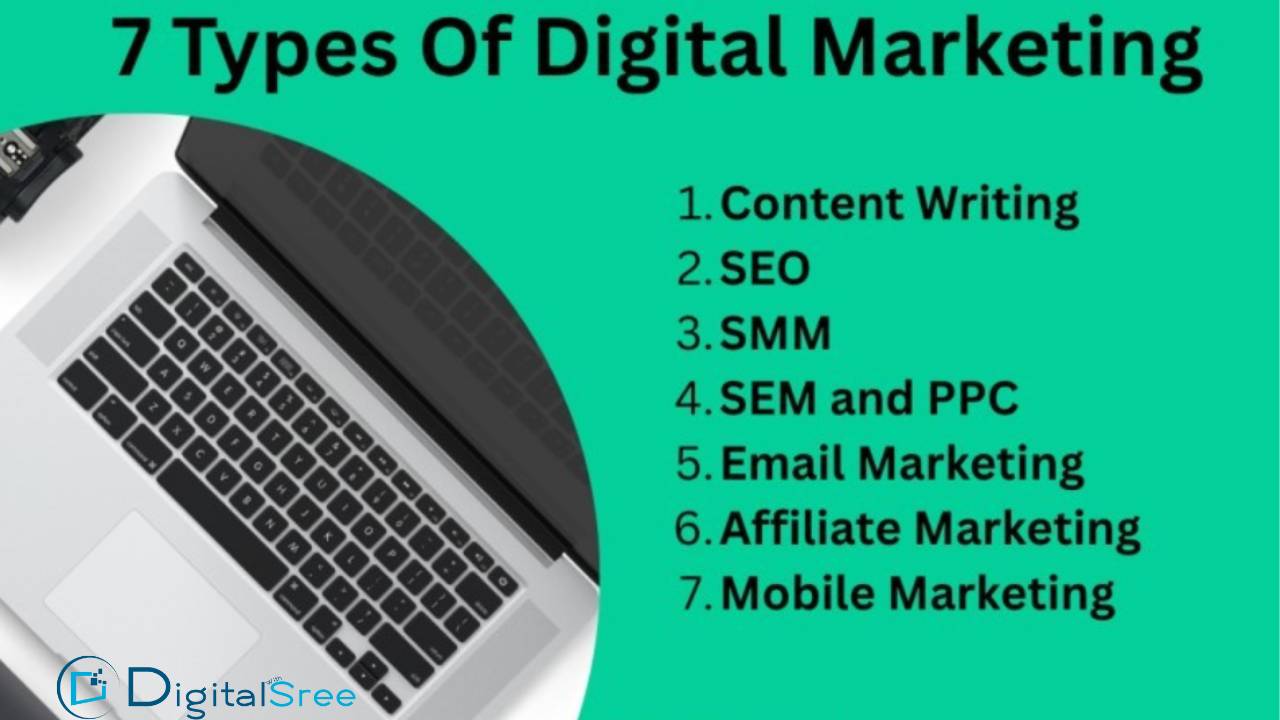
Below are the 7 types of Digital Marketing which plays an important role in this dominative business world.
1.Content Marketing
Content Marketing is the process of creating, sharing, and distributing valuable content pieces such as videos, blogs, and infographics to attract a specific audience. The importance of digital marketing in content marketing is that it establishes your brand as an authoritative figure within the space and builds trust. Using content marketing tips, useful content gets customers through the buying journey, thereby increasing conversions.
Forms of Content Marketing
Content can take many forms based on the specific platform and target audience.
- Blog posts – Articles that help solve specific issues and educate people.
- Videos – Content that is useful for people on social media and YouTube.
- Infographics – Use of images to represent data or processes.
- Podcasts – Content that can be listened to and is useful while on the move.
- E-books/Guides – Materials which provide practical value.
- Case studies – Practical illustrations of the achievement of the brand or the solution for your audience.
- Social media posts – Content made for brand awareness and can be shared easily.
How It Works
Step 1– Identify your target audience. Understand the people’s needs.
Step 2–Create useful content. Develop content around issues that help solve or answer commonly asked questions.
Step 3–Distribute content. Share your content on the website, blog, YouTube and social media channels.
Step 4–Track and measure. Monitor the engagement and interaction of users with performance.
Step 5–Convert and retain. Use calls to action like free trials and email signups to turn the audience from passive readers and viewers to active, loyal customers.
Examples
- A fitness brand is publishing workout tips and healthy recipes on its blog.
- A digital marketing agency sharing YouTube videos explaining SEO techniques.
- A SaaS company offering a free e-book on “Email Marketing Strategies for Beginners” in exchange for email signups.
- A travel company posting Instagram stories and reels showcasing exotic destinations with travel tips.
2.Search Engine Optimization (SEO)
The importance of digital marketing in SEO is that it improves your website’s visibility on search engines, helping you attract more organic traffic and potential customers.
Three Different Types of SEO
The main 7 types of digital marketing, SEO has 3 main parts:
On-page SEO involves focusing on the URL structure, headings, meta tags, content, and keywords.
- Obtaining backlinks from other reputable websites is known as off-page SEO. We have to know more about the off-page SEO checklist.
- Technical SEO includes the website’s speed, mobile friendliness, and ease of crawling and indexing.
Main Methods
- Finding relevant keywords
- Creating top-quality content
- Acquiring links
- Optimising meta headings and titles
- Boosting site speed and mobile responsiveness.
Example
A website about cooking optimises a blog called “Best Healthy Breakfast Recipes” by relevant keywords, placing quality images with appropriate alt texts, and acquiring backlinks from blogs about nutrition. Here, the importance of digital marketing can be easily seen.
3.Social Media Marketing (SMM)
Social media marketing,one of the important 7 types of digital marketing, includes promotion and customer interaction on content developed and posted on Facebook, Instagram, X (Twitter), LinkedIn and TikTok.
Goals
- Boost awareness of your brand
- Increase website traffic
- Produce sales and leads
- Increase community involvement
- Offer customer assistance
Examples
- A cosmetics company using Instagram Reels to share makeup tutorials
- A tech startup collects user information through LinkedIn polls
- A clothes retailer holding Facebook giveaways.
The importance of digital marketing in SMM can be easily seen.
4. Search Engine Marketing (SEM) and PPC
As part of SEM, which is a form of paid advertising, the search engine results pages (SERPs) show ads. A marketer using PPC (Pay-Per-Click) model pays every time someone clicks on their ad. The importance of digital marketing in SEM and PPC is mainly the easy visibility of results in business.
Platforms
- Google Ads
- Bing Ads
- YouTube Promotions
- Sponsored Ads on Amazon
Why It Is Important
Rapid traffic and visibility enable accurate targeting according to search intent, interests, and demographics, helping companies compete, even with recently launched websites.
Example
A local dentist runs Google Ads for “best dentist near me” and pays only when someone clicks on the ad.
5. Email Marketing
Email marketing is the practice of sending personalised emails to a list of subscribers to promote products, offer updates, cultivate prospects, or build relationships. The importance of digital marketing in Email is that it offers a low-cost, direct, and personalised way to reach customers and build long-term relationships. Nowadays, the advantages of Email Marketing are vast.
Uses
- Promotions of product(s)
- Newsletters
- Emails for Welcomes
- Recover shopping carts that are left behind
- Gather feedback from customers
Steps of Email Marketing Strategies
- List Building – Capture emails through lead forms
- Segmentation – Divide the lists into groups by interests and/or actions
- Email creation – Develop emails that are personalised and compelling
- Sending and analysis – Send emails and monitor the open and click rates
Example
Happy discount customers are emailed a welcome ‘10% off coupon’ upon sign-up for the newsletter for the first time.
6.Affiliate Marketing
This is a type of marketing that relies upon performance. The importance of digital marketing in affiliate marketing is that it allows businesses to increase sales through trusted partners while paying only for actual results. Here, an affiliate earns money from each sale made through each individualised code or link given by the business and promoted by the affiliate through the website, blog, or social media.
How It Works?
A link and a product are provided by the vendor
- The Affiliate promotes the blog and/or social media
- The customer purchases the product using the vendor’s link
- The affiliate receives the profit share
Example
If a tech blogger includes an affiliate link, and reviews the laptop on Amazon, then takes a percentage off from each sale the reader buys from through that link.
7.Mobile Marketing
Mobile marketing is concerned with the communication to users of smartphones and tablets through messages, ads, apps, and sites optimised for mobile. The importance of digital marketing on mobile is that it helps businesses reach customers instantly on their smartphones, where they spend most of their time. In this, successful WhatsApp marketing plays an important role.
Principle Mobile Marketing Techniques
- SMS and MMS advertising
- In-app advertisements
- Websites that are geared for mobile
- Push alerts
- QR codes
- Location-based advertisements
Example
During peak lunch time, a restaurant SMS coupon is offered to nearby users and provides a web link to order food online.
Benefits of Digital Marketing
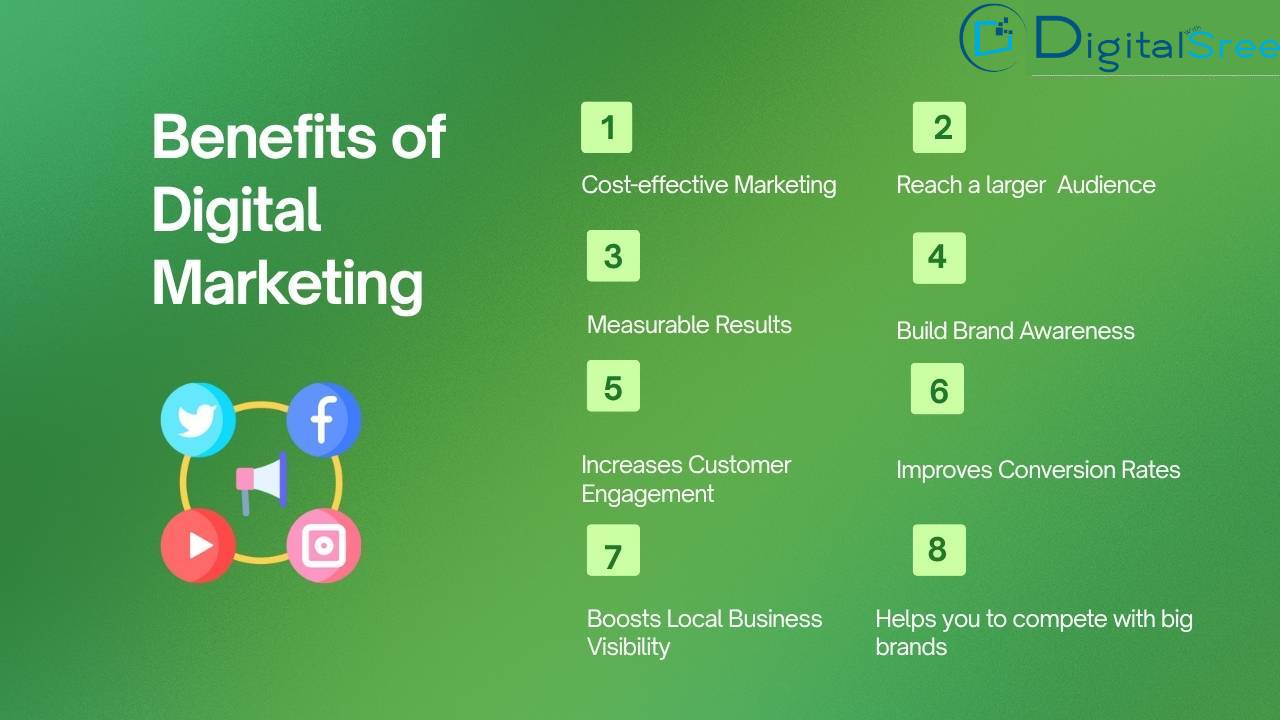
Digital marketing has helped businesses communicate with their audience and smartly advertise their products and services. The importance of digital marketing in today’s competitive environment is to build trust, grow sales, and do so in a cost-effective manner.
1. Cost-effective Marketing
Ads in newspapers and on TV, and radio are more expensive than digital marketing.You can choose a budget to spend, and it still reaches many people.
2. Reach a Larger Audience
Digital marketing allows the targeting of a very specific audience according to their age, interests, and geographic location instead of random viewers.
3. Measurable Results
Digital marketing allows real-time tracking of the audience’s response to the marketing content with a click, like, and purchase and can make needed changes.
4. Build Brand Awareness
Regular and frequent posting on social platforms and websites develop brand recognition. The advertisement of digital content makes people recognize it easily..
5.Increases Customer Engagement
Digital platforms offer direct channels of communication that encourage customer chats, comments, and feedback. The businesses can understand the audience’s interests and preferences.
6. Improves Conversion Rates
People can easily be directed to complete an action with online ads and campaigns like purchasing an item or registering to receive information. Sales can be increased quickly with simple calls to action and easily navigable webpages.
7. Boosts Local Business Visibility
Nearby customers can access information about your business through Google My Business and Local SEO. This results in more frequent local visits and new customers that will continue to return.
8. Helps You To Compete With Big Brands
An effective and established online presence enables small companies to challenge large corporations. Even small businesses can reach a large number of customers with innovative and well-planned strategies.
Conclusion
For businesses and digital marketers, understanding the 7 types of digital marketing — SEO, content marketing, social media marketing, email marketing, SEM, PPC, affiliate marketing, and mobile marketing — is essential for effective growth. Using the right combination of these strategies helps attract qualified leads, strengthen brand visibility, and deliver measurable results that support long-term business success.
FAQ
1.What are the main types of digital marketing?
The types of digital marketing that are common are the following: Search Engine Optimization (SEO) marketing), PPC (Pay-Per-Click Advertising), social media marketing, content marketing, email marketing, affiliate marketing, video marketing, and mobile marketing.
All of these, in correlation with the aligned business goals, are useful in their own ways. Goals are custom strategic blueprints whether listed objectives.
2.Which type of digital marketing is best for beginners?
Beginners can consider Social Media Marketing and Content Marketing as a starting point.
These are the easiest, cheapest, and quickest to execute with the most effective results. Once you gain some level of mastery, consider trying the more complex aspects like SEO or PPC.
3. What is the difference between SEO and PPC?
SEO is the unpaid and organic traffic from search engines, while PPC is the paid advertisement traffic from search engines and social media. SEO takes more to develop while PPC is instantaneous.
4.Why is Mobile Marketing important today?
Most people are mobile users and do their browsing, shopping and connecting with brands via the phone.
Therefore, mobile marketing opens opportunities for high engagement and more personalised marketing strategies via router, sms, and personal location-targeted ads.
5.How do I know which digital marketing strategy is best for my business?
The most suitable strategy for digital marketing hinges on many factors, such as audience segmentation, budget allocation, and set objectives.
In this instance, if your goal is to achieve brand awareness, you would devote your attention to social media structures; for leads and sales, you would invest in PPC or Email Marketing; while for sustainable growth, you would focus on SEO in conjunction with Content Marketing.